

Hygiene problems with office water dispensers usually have less to do with the machine than with habits of use and management: a spout touched by a bottle, a hot water button with no anti-scald design, a cartridge six months past its date that nobody remembers. This article works through the risks one at a time — every one of them something we have actually seen on maintenance visits over nearly thirty years — and sets out what you can handle yourself and what should go to the supplier.
One: dispensing-point hygiene — cross-contamination is the most common risk
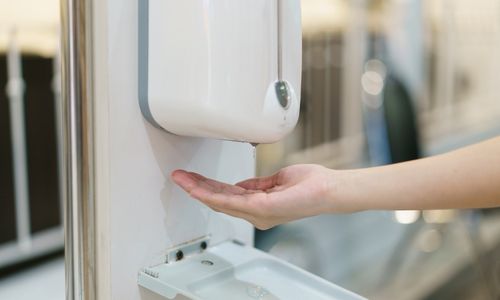
The part of a dispenser most likely to cause trouble is not the water, it is the spout. Common sights: a colleague pressing the mouth of a bottle straight against the spout, a reusable cup that has gone unwashed for days, paper cups opened and left loose on top of the machine. Habits like these turn the spout into a point of cross-contamination, and no amount of good filtration makes up for it.
- Do not let bottles or cups touch the spout while dispensing — a notice beside the machine is the most effective place for this one.
- Encourage colleagues to use reusable bottles and wash them regularly; if paper cups are provided, keep them in a covered container away from moisture.
- Wiping the spout and the drip tray can be folded into the daily cleaning; for how often and how, seeManaging drinking water hygiene in the office.
Two: hot water safety — scald risk and placement
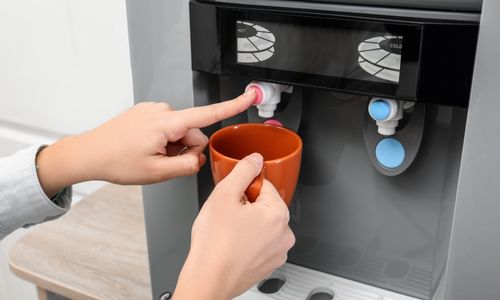
Hot water in an office dispenser is generally above 85°C — right for noodles and coffee, and quite enough to scald. A risk assessment really needs only three questions: who uses it (do visitors bring children?), where is it (a corner where people collide?), and what is the floor like (could drips make someone slip?).
- Choose a model with a hot water safety lock; in an office where visitors or family members come by, a safety lock should not be treated as optional.
- Put the dispenser somewhere level and against a wall, away from doorways and traffic corners, and keep the socket out of direct steam.
- An overflowing drip tray is the main cause of a slippery floor — emptying it once a day is less work than mopping afterwards.
Three: cartridges and internal hygiene — an expired cartridge is an invisible problem
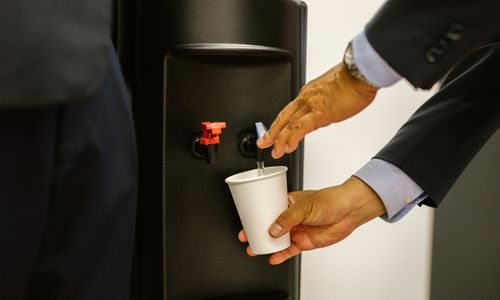
The cartridge is at the heart of a dispenser's hygiene, and it is the part most often forgotten. What we see most often on site is a machine spotless on the outside and, once opened, a cartridge a year past its date. Beyond the drop in filtration performance, the filter medium itself can become a place where things accumulate — and none of it shows from the outside.
- General guidance on replacement cycles: pre-filters generally once a year, RO membranes generally every two to three years, subject in practice to the maintenance arrangement.
- Cleaning the internal tank and pipework falls within maintenance. It takes tools and experience in dismantling the machine, so it should be done by a technician during scheduled servicing rather than at your own hand.
- Put the cartridge date somewhere obvious on the machine. Bio-Link's maintenance customers do not have to keep track themselves — when the replacement month comes, we contact you to arrange it.
For a full breakdown of cartridge cycles, the division of cleaning duties and service responsibility, seethe office water dispenser maintenance guide.
Four: contingency — with leaks and faults, knowing who to call matters most
A plumbed-in dispenser connects to both the water supply and the power, and when something goes wrong the loss is usually not the machine but the time: a leak soaking the carpet, a tripped breaker taking out other equipment on the same circuit. Two things are enough to have a contingency in place:
- Know where the stopcock and the power are— ask the installer to show the administrator once. If you find a leak, close the stopcock first, then cut the power, and leave the rest to the supplier.
- Know where responsibility lies— with a rental, repair responsibility generally sits with the supplier; with a purchase it depends on the maintenance arrangement. Asking about the reporting channel and the response time when you sign is easier than arguing about it afterwards. Bio-Link's arrangement is a site visit within two working days.
Conclusion
For hygiene and safety on an office dispenser, four things cover the great majority of the risk: keep the dispensing point clean, have an anti-scald arrangement for hot water, replace cartridges on schedule, and know who to call. The first two come down to daily habits, the last two to the supplier's maintenance system — so when choosing aOffice Water Dispenser, the maintenance arrangement deserves to sit on the same scales as the model itself.
About Bio-Link
Bio-Link (霸力純水濾水系統) is one of Hong Kong and Macau's longest-established reverse-osmosis (RO) drinking-water specialists, operating since 1997 — nearly three decades focused almost entirely on RO. We supply, install and maintain direct-piped RO and UF drinking-water systems for homes, offices, schools, clinics, restaurants and hotels across Hong Kong and Macau, with one company handling supply, installation and maintenance end to end, to buy or to rent, with clear costs. Our full filtration line is SGS-tested and designated models meet NSF 42 & 58; Bio-Link is a certified Social Enterprise (HKCSS / SEE Mark SEE0195).
Frequently asked questions
How often should an office water dispenser be cleaned?
The spout and drip tray are best wiped daily and the outside of the machine weekly; cleaning the internal tank and pipework falls within scheduled maintenance and is handled by a technician. For the division of daily cleaning duties, see our guide to managing drinking water hygiene.
What goes wrong if a cartridge is used past its date?
Filtration performance drops, and the filter medium itself can become a place where impurities accumulate — none of which is visible from the outside. Pre-filters are generally replaced once a year and RO membranes every two to three years, subject in practice to the maintenance arrangement.
What should you do if a water dispenser leaks?
Close the stopcock first, then cut the power, and contact the supplier to report it. It is worth asking the technician at installation to show the responsible colleague where the stopcock and the power are, so there is no hunting for them in the moment.
Further information: Beware of contamination in distilled-water dispensers — CHOICE Magazine issue 334 | Consumer Council (consumer.org.hk)