When an office moves from bottled or barrelled water to a plumbed-in systemOffice Water Dispenser, the most immediate environmental benefit is that the whole chain — bottling, delivery, storage, disposal — disappears at once. This article sets out six environmental benefits one by one, and counts honestly the environmental costs a direct-drinking dispenser carries of its own.
1. No more single-use bottles — and you can do the arithmetic yourself
Take a standard 500 ml bottle as the unit: each one avoided saves an estimated 10 grams of PET plastic and around 0.08 kg of carbon emissions (covering the bottle's production, transport and disposal, on conservative estimates). In a 20-person office, if each person uses one bottle fewer per working day, that runs into thousands of single-use bottles over a year. Every assumption and conversion behind those estimates is published in full in theEnvironmental benefit estimation methodology— every assumption takes the conservative end, so the numbers stand up to questioning.
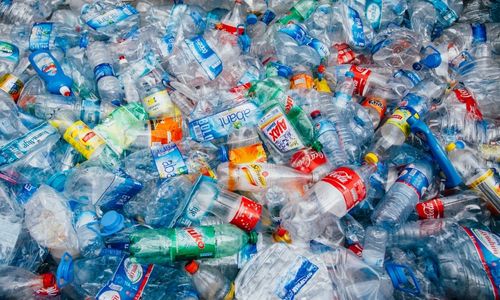
2. Lower carbon emissions — what you save is the whole delivery chain
The carbon footprint of bottled water is not just the bottle: the production line at the bottling plant, the lorry delivering case by case to the building, the collection and processing after it is drunk — every leg counts. A direct-drinking dispenser takes water straight from the building's own supply, so the transport leg falls essentially to zero. One point to be clear about: these are estimates of avoided emissions. Bio-Link makes no carbon-neutrality claim — the two are different orders of statement, and the methodology page explains why.
3. The water ledger: RO does produce waste water, and the balance still favours it
To be honest about it, RO filtration produces waste water. That is part of how reverse osmosis works and we are not going to pretend otherwise; ultrafiltration (UF) systems produce none. On the other side, the water consumed in producing and washing bottles goes well beyond the 500 ml inside them. Put both on the same scale and the plumbed-in option still comes out ahead on total water use — but that conclusion is calculated, not shouted.
4. Energy: the dispenser draws power, but it saves the power spent on refrigeration and haulage
The chilled and hot functions do need electricity, and we are not dodging that either. What is saved sits at the other end of the chain: the energy of the bottling line, refrigerated storage, lorry fuel. When choosing a machine, look for models with an energy-saving mode and match the capacity to the actual headcount — an oversized machine wastes power holding water hot on standby, an undersized one cannot cope at peak, and neither is environmentally sound.
5. Less storage and handling: the pantry stops doubling as a warehouse
One environmental cost of barrelled water is routinely overlooked: storage. The space a batch of barrels occupies, the labour of carrying them in and out, the back-and-forth of over-ordering and holding stock or under-ordering and running dry — every re-delivery is another journey. A plumbed-in dispenser removes all of it, and the pantry goes back to being a pantry. For a full cost breakdown of the water-delivery model, seeHow water delivery pricing is calculated.
6. Working with the plastics regulations and with ESG reporting
Hong Kong's regulation of disposable plastic tableware is already in force, and requirements on single-use plastics in hotels and in food and beverage are tightening step by step (seeWater arrangements for hotels and food and beverage under the new plastics rules). At company level, plastic-reduction figures are one of the few items in an ESG report where doing the thing produces a number you can actually report. Using the estimation method above, the bottles avoided in a year, the weight of plastic reduced and the carbon emissions avoided can each be listed, with the method cited.
In conclusion: an environmental account only counts if the costs are counted too
The environmental benefit of a direct-drinking dispenser is real: the entire bottling and delivery chain disappears, single-use plastic drops, and the pantry no longer holds stock. Its own costs — RO waste water, the electricity for chilled and hot — are just as real, and we count them; once counted, the ledger still leans clearly towards the plumbed-in side. To run the numbers for your own headcount, the conversion on the methodology page takes about ten minutes.
If you are choosing a dispenser for an office, Bio-Link's options include:
- ST1523: a 23-litre hot tank with RO filtration, suited to large offices.
- ST9102: a three-temperature floor-standing unit that balances capacity against footprint, suited to medium-sized offices.
- ST290RO: a compact body with RO filtration, suited to small offices.
About Bio-Link
Bio-Link (霸力純水濾水系統) is one of Hong Kong and Macau's longest-established reverse-osmosis (RO) drinking-water specialists, operating since 1997 — nearly three decades focused almost entirely on RO. We supply, install and maintain direct-piped RO and UF drinking-water systems for homes, offices, schools, clinics, restaurants and hotels across Hong Kong and Macau, with one company handling supply, installation and maintenance end to end, to buy or to rent, with clear costs. Our full filtration line is SGS-tested and designated models meet NSF 42 & 58; Bio-Link is a certified Social Enterprise (HKCSS / SEE Mark SEE0195).
Frequently asked questions
Is a direct-drinking dispenser really greener than bottled water?
Counted in single-use bottles avoided, the benefit is real: each 500 ml bottle avoided saves an estimated 10 grams of PET plastic and around 0.08 kg of carbon emissions. The dispenser's own electricity use and RO waste water are already taken into account, the overall ledger still comes out ahead, and the estimation method is published in full.
Is the waste water from an RO dispenser wasteful?
RO filtration produces waste water; that is part of the principle. If waste water is a particular concern, a UF ultrafiltration system produces none. Compared with the water used across the whole bottled-water production chain, total water use on the plumbed-in option is still lower.
Can switching to a direct-drinking dispenser go into an ESG report?
Yes. Using the published estimation method, the bottles avoided in a year, the weight of plastic reduced and the carbon emissions avoided can each be listed, with the method cited. Note that these are estimates of avoided impact and do not constitute a carbon-neutrality claim.
Further Reading:Water for Free